
Iron Deficiency and Celiac Disease: What Nobody Told Me
Iron deficiency is one of the most common — and most overlooked — consequences of celiac disease. Here's my personal story, the symptom that shocked me, and everything you need to know about iron and celiac disease.
Giselle Meireles
5/30/20266 min read
It Started With the Worst Phone Call of My Life
There are moments that divide your life into before and after.
For me, one of those moments was the phone call telling me my mother had been diagnosed with cancer. She was in Brazil. I was in Australia — on the other side of the world, separated by 14,000 kilometres and an ocean.
I was on a plane within days. I spent weeks by her side in hospitals, watching her fight, trying to be strong while feeling completely helpless. The fear, the exhaustion, the grief of watching someone you love suffer — it hollowed me out in ways I didn't fully understand at the time.
Many autoimmune diseases have an emotional trigger — a period of intense stress that seems to activate something that was already waiting in the body. I can't say for certain that my mother's illness triggered my celiac disease. But the timing was not lost on me. Within two months of returning to Australia, my body had begun to fall apart in ways I had never experienced before.
I was exhausted in a way that sleep couldn't fix. Walking a short distance left me breathless. I wanted nothing more than to stay in bed. And somewhere underneath all of it, my iron stores were quietly disappearing.
Ferritin Level: 6
When my doctor in Australia ran my first blood test, my ferritin came back at 6.
Ferritin is the protein that stores iron in your body — think of it as your iron reserve tank. The normal range is between 30 and 200. Mine was 6. My doctor told me it was so low it was practically non-existent.
He didn't wait. The next day I was booked in for an intravenous iron infusion.
What Is Iron Deficiency Anaemia — And Why Celiacs Are So Vulnerable
Iron deficiency anaemia occurs when your body doesn't have enough iron to produce adequate haemoglobin — the protein in red blood cells that carries oxygen around your body. Without enough oxygen reaching your cells, everything suffers: energy, concentration, mood, physical strength.
For people with celiac disease, iron deficiency is one of the most common complications — and one of the most frequently missed.
Here's why: iron is absorbed primarily in the duodenum and upper small intestine — exactly the area where celiac disease causes the most damage. When the intestinal villi are flattened and inflamed from years of gluten exposure, the gut simply cannot absorb iron properly, no matter how much iron-rich food you eat.
This is why so many celiacs — particularly women — spend years being treated for anaemia without anyone investigating the root cause. The iron keeps disappearing because the gut keeps failing to absorb it. It's a cycle that only breaks when the underlying celiac disease is diagnosed and treated.
Intravenous Iron: What It's Like
For many celiacs with severely depleted iron stores, oral iron supplements are not enough — at least not initially. When ferritin is critically low, the body needs iron delivered directly into the bloodstream.
My infusion lasted around one and a half hours. It has to be administered slowly — too fast and it can cause nausea, dizziness, or more serious reactions. I sat in a clinic with a drip in my arm, willing my body to accept what it had been missing for so long.
The difference was remarkable. Within two weeks, I felt meaningfully better. Not completely well — that would take much longer — but the crushing, bone-level fatigue began to lift. I could walk without feeling breathless. I could think more clearly.
Oral iron supplementation can take up to two months to make a significant difference when levels are very low. Intravenous iron works in two weeks. For someone who had been struggling for months, those extra weeks mattered enormously.
The Symptom That Nobody Told Me About — And That Nobody Believed
This is the part of my story I almost didn't include, because I worried people would think I was exaggerating.
Every single time my ferritin dropped — and it dropped three times before my celiac diagnosis gave us the full picture — I developed an uncontrollable urge to chew ice.
Not sip cold drinks. Not enjoy ice in a glass. Chew ice. Constantly. I would fill a glass with ice and crunch through it compulsively, multiple times a day. It felt like a craving I couldn't ignore.
I mentioned it to a few people and got puzzled looks. Nobody connected it to anything medical.
Then one day, curious and slightly desperate for an explanation, I searched online. And there it was.
Pagophagia — the compulsive craving to chew ice — is a recognised symptom of iron deficiency anaemia. It falls under a broader condition called pica, where the body craves non-nutritive substances. Researchers aren't entirely sure why iron deficiency triggers ice cravings specifically, but one theory is that chewing ice may temporarily increase alertness in people whose brains are oxygen-deprived due to anaemia.
All three times my ferritin crashed, the ice craving appeared. All three times my levels recovered, it disappeared completely.
Your body speaks to you in ways that aren't always obvious. When something feels strange or compulsive and you can't explain it — it's worth investigating.
Other Signs Your Iron May Be Low
Beyond the ice craving, these are the symptoms I experienced — and that research consistently links to iron deficiency:
Extreme fatigue that doesn't improve with rest
Shortness of breath with minimal exertion
Brain fog and difficulty concentrating
Hair loss — this one came back every time my ferritin dropped. The hair follicle needs iron to function. When stores are low, the body prioritises other functions and hair growth suffers
Pale skin and pale inner eyelids
Cold hands and feet
Headaches
Heart palpitations
Brittle nails with ridges or spoon-shaped depressions
Restless legs — particularly at night
Cravings for ice, dirt, or other non-food substances (pagophagia/pica)
A Special Note for Women with Heavy Periods
If you have celiac disease and also experience heavy menstrual bleeding, please pay close attention to your iron levels — and ask your doctor to monitor them regularly.
I have both. And the combination makes iron management significantly more challenging. Every month, blood loss compounds the absorption problem. Even when supplementing, levels can drop again quickly after a heavy period.
This was part of why my ferritin kept crashing before my celiac diagnosis. My doctor initially attributed my anaemia entirely to my heavy periods — which was understandable, but incomplete. The real picture was malabsorption plus blood loss, working together against my iron stores.
If your anaemia keeps returning despite treatment, please ask specifically about celiac disease testing.
Foods Rich in Iron — What to Include in Your Diet
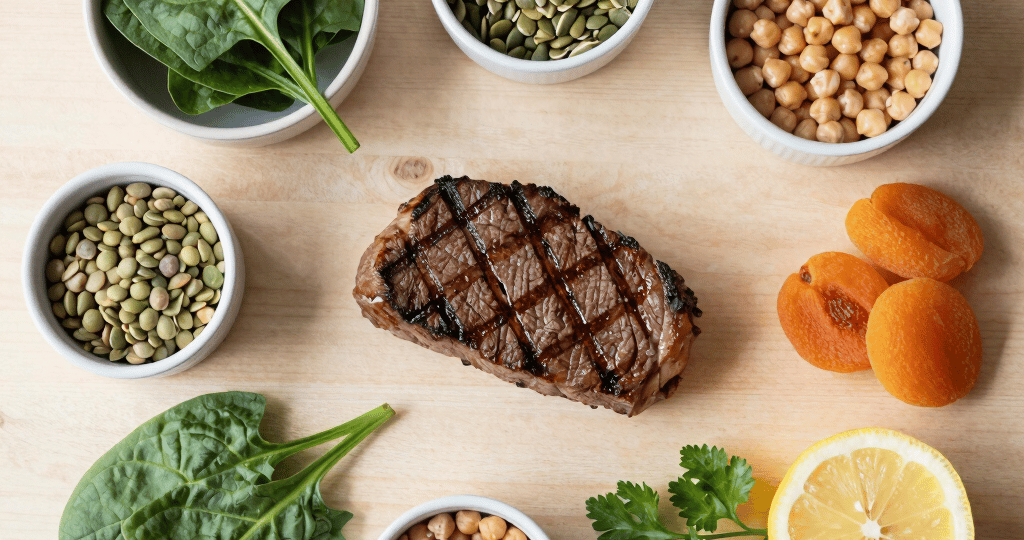
While supplementation is often necessary for celiacs, building an iron-rich diet is an important part of long-term management. Here are the best sources:
Haem Iron (most easily absorbed — from animal sources):
Red meat — beef, lamb (one of the richest sources)
Liver and organ meats
Chicken, particularly dark meat
Fish and shellfish — especially oysters, clams, sardines
Eggs
Non-Haem Iron (plant-based — less easily absorbed, but valuable):
Legumes — lentils, chickpeas, kidney beans
Tofu and tempeh
Dark leafy greens — spinach, kale, silverbeet
Pumpkin seeds
Quinoa
Dried apricots and figs
Fortified gluten-free cereals
The Golden Rule — Always Pair Iron with Vitamin C
Non-haem iron absorption increases significantly when consumed with Vitamin C. Squeeze lemon over your spinach. Add capsicum to your lentil soup. Have a glass of orange juice with your iron supplement.
Conversely, avoid drinking tea, coffee, or consuming dairy within an hour of your iron-rich meal or supplement — these can inhibit absorption significantly.
How Long Does It Take to Rebuild Iron Stores?
This is one of the most common questions — and the honest answer is: it takes longer than most people expect.
Even with supplementation and a strict gluten-free diet allowing the gut to heal, rebuilding ferritin stores can take 6 to 12 months or longer. The gut needs time to repair before it can absorb iron efficiently again.
Regular blood tests every 3 months in the first year after diagnosis are important to track progress and adjust supplementation as needed. Don't stop supplementing just because you feel better — ferritin levels can lag behind how you feel.
What I Know Now That I Wish I'd Known Then
Iron deficiency and celiac disease are deeply connected — and yet so many women spend years treating the symptom without finding the cause.
If your iron keeps disappearing despite treatment, ask about celiac disease. If you have celiac disease, monitor your iron levels regularly. If you're chewing ice compulsively and nobody can explain why — it might be worth a blood test.
Your body is always trying to tell you something. The more fluent you become in its language, the better you can care for it.
Next read: [My Gluten-Free Meal Prep Routine →]
Disclaimer: This post is based on my personal experience and general health information. Always consult a qualified medical professional before starting any supplementation protocol or making changes to your treatment plan.
References:
Tye-Din JA. Iron deficiency anaemia and celiac disease. Medical Journal of Australia, 2016.
Kettaneh A, et al. Pica and food craving in patients with iron deficiency anaemia. American Journal of Medicine, 2005.
Coeliac Australia. Nutrient deficiencies and coeliac disease. coeliac.org.au
Crosby WH. Pica: a compulsion caused by iron deficiency. British Journal of Haematology, 1976.
VitalAura
A wellness blog focused on healthy living, gut health, food intolerances, and realistic wellness for women after 30.
Contact
Newsletter
© 2026 VitalAura. All rights reserved.